


News, page #9
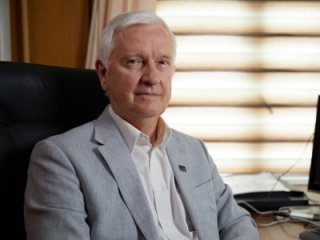
Are the residents of Earth protected from asteroids? The opinion of Boris Shustov, head of Expert Working Group for Space Threats under the Space Council of RAS
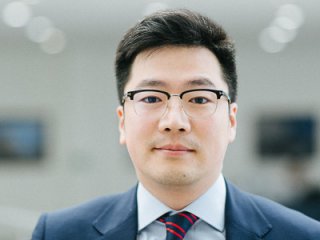
Impact of pandemic on oncological aid in Russia, COVID-19 vaccination for oncological patients, scientific trends and applications enjoying priority in oncology

He wrote from 25 countries, bathed in all oceans and could have become the first journalist in space: June 2 is the birthday of Yaroslav Kirillovich Golovanov, journalist and science popularizer
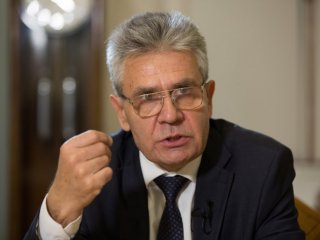
On June 1, on the TV channel Rossiya 24, Aleksandr Sergeev, President of the Russian Academy of Sciences, spoke of the importance of preserving cooperation between Russia and the US despite complications between Moscow and Washington
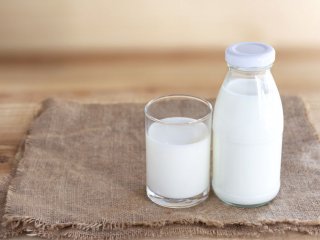
Initiated by the Food and Agriculture Organization of the United Nations, World Milk Day was first celebrated in 2001
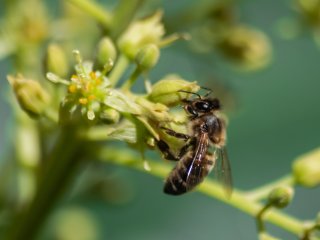
Russians are warned against gathering small clusters of white flowers in forests. May lily is both a dangerous flower and a Red Book specie. This material is about the plants growing in forests and fields that should be avoided.
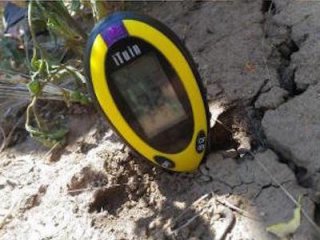
Scientists from Volgograd-based Federal Agroecology Research Center (FARC) of RAS study promising untraditional ameliorant fertilizers based on anthropogenic (sewage sludge) and natural (for instance, glauconite) components
On the last Sunday of May, Russian chemists celebrate their professional holiday.
Specialists of the Marine Hydro-Physical Institute perform research devoted to microplastic contamination of sea environment on Russia’s territory
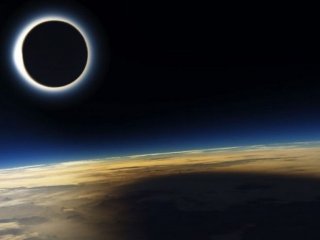
On May 29, 1919, Arthur Eddington recorded a total solar eclipse on camera
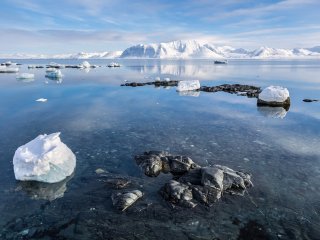
An iceberg chipped off the coast of Antarctic. Its area is 4,320 km2 (1.5 areas of Moscow, 3 territories of St. Petersburg, or 5 territories of Volgograd). The story of icebergs.
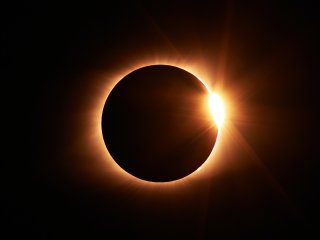
On May 29, 1879 Milutin Milankovic, Serbian mathematician, astronomer, geophysicist, engineer, and writer, was born.
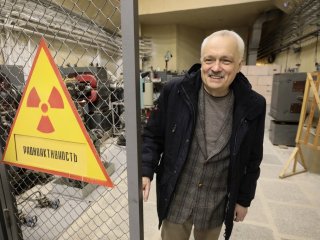
Scientific Russia visited Protvino to see U-70 accelerator complex
At the international academic symposium, Russian and foreign scientists discussed COVID-19 pandemic, subsequent risks, and the process of solving emerging problems.
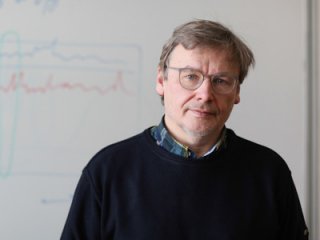
The 21st century has every chance of going down in history for breakthrough discoveries in human brain research. Konstantin Vladimirovich Anokhin, Academician of the Russian Academy of Sciences, believes that this would require a basic theory of the brain
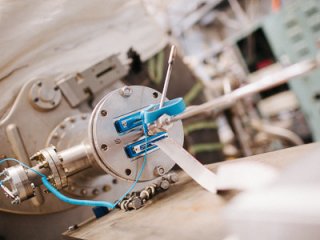
If there is dark matter, what particles does it consist of? The answer has been pursued for several decades in Troitsk at the Institute for Nuclear Research, conducting a unique Troitsk nu-mass experiment.
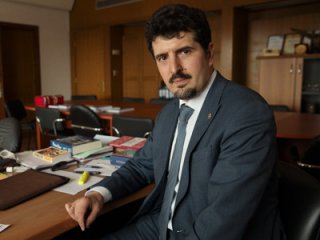
M. A. Lipkin, Director of the Institute of World History of the Russian Academy of Sciences, Corresponding Member of the Russian Academy of Sciences, Professor of the Russian Academy of Sciences, speculates how the big history is swayed today, whether we need books, and why science is getting more important in society.
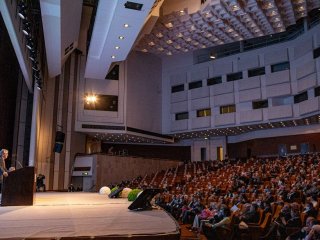
Today, on May 26, the Third International Moscow Academic Economic Forum (MAEF) started its work.
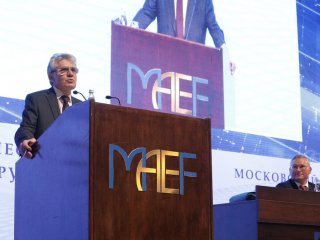
On May 26, the Third International Moscow Academic Economic Forum started its work. The topic of MAEF 2021 is Global Transformation of Modern Society and National Development Goals of Russia.
Partners
Show all










Our mobile application


Social networking
Recent
Popular
Lectures
What did Fock mean when he said that Einstein hadn’t understood his own theory? What principles was Einstein's theory of gravity meant to be based on? Why did Einstein doubt the completeness of quantum theory?
